Math · 6–12 yrs · 4 min read
Making Fractions Meaningful: From Hands to Symbols
Paper folding and equal sharing give children a concrete foundation for understanding fractions before written calculations.
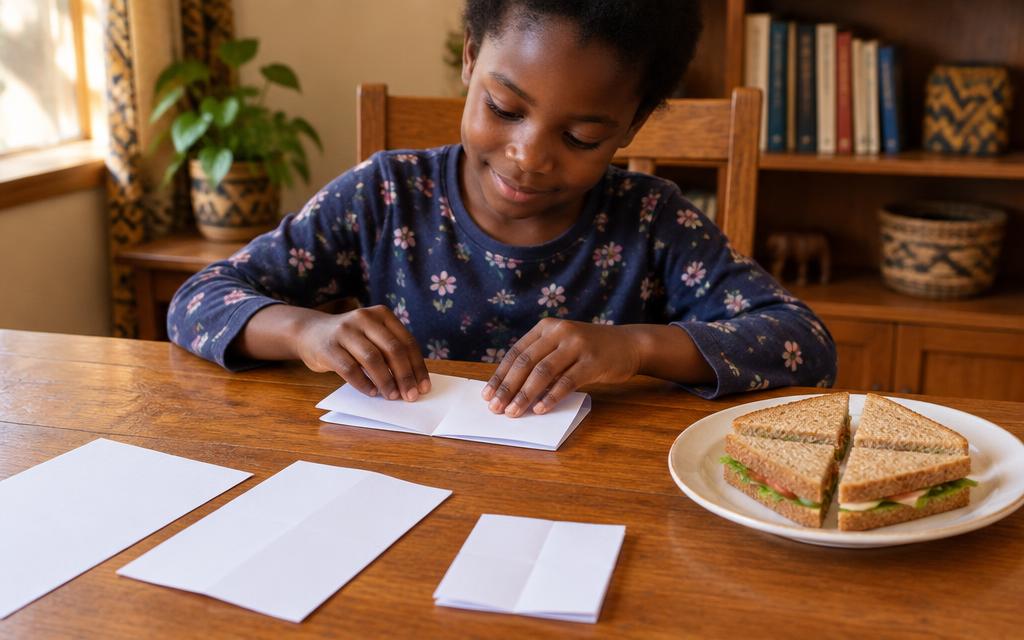
Start with an equal whole
Fold one sheet of paper into two equal parts, then another same-sized sheet into four. Open them and name halves and quarters. Explain that fraction parts must be equal and that comparisons need the same-sized whole. Let your child fold and check rather than just watch.
Explore before naming rules
Compare one half with two quarters using the folded sheets. Ask what your child notices. Draw the parts, then introduce the symbols 1/2 and 2/4 alongside the models. Revisit the objects whenever a symbol feels confusing.
Connect to everyday situations
Share a sandwich equally or measure ingredients together. Ask how to make a fair share and how your child can check it. Match the challenge to readiness: one child may be exploring halves while another is ready to investigate equivalence or combine fractions with the same denominator.
Move towards abstraction at the child's pace
Invite your child to record a discovery in words, pictures and symbols. Keep the concrete materials available, even when written work begins. A mistake is a reason to compare the model and the recording together, not a sign that speed drills are needed.